It’s a cold day today, but in a spring way, and I love you.
(24th March, 1937; Letters to Véra by Vladimir Nabokov)
The slog of January to very early Feb was one, for us, submerged in greyness. The first month of the year seemed to last forever, yet with no real sense of the days passing by. Just fog!
Our vitamin D levels dwindled as there was absolutely no visible sun; those select mornings when it did make a short appearance saw us all vastly uplifted.
It was a Valentine’s Day visit to Whitby with family that I only properly remember a completely blue sky… I have a fond recollection of a couple sitting in a bus stop, sunbathing in five-degree cool. Romantic!
Blue sky through Whitby Abbey
As I experience more years (having recently (reluctantly) turned twenty-five), I grow increasingly impatient for spring’s arrival. Not just for the daffodils, lambs and chocolate eggs, but more so for the longer days and increased likelihood of sunshine. With longer evenings on their way, I feel less inclined to convince myself I’m running out of time.
Over winter, I wilt – a plant without what it needs – I’ve come to find the transition back into green, yellows and pinks more and more welcome. Everything shifts, in a flowery sort of way (colour comes back).
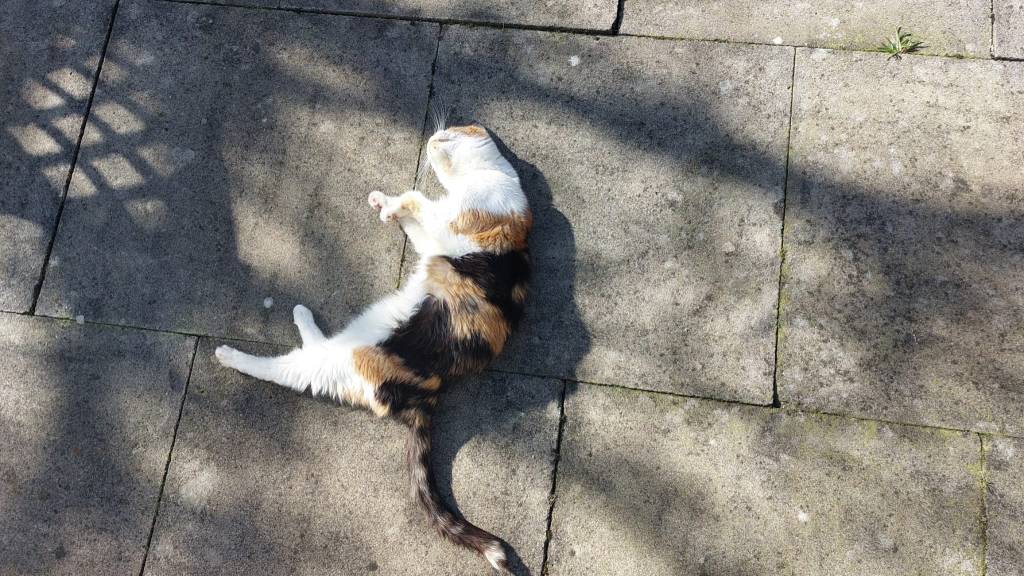
A usual indication of the change in season is our cat basking on the garden patio. She’ll only do this when the conditions are just right, and it seems that today the stone is at optimum temperature:
Cali in the afternoon sun
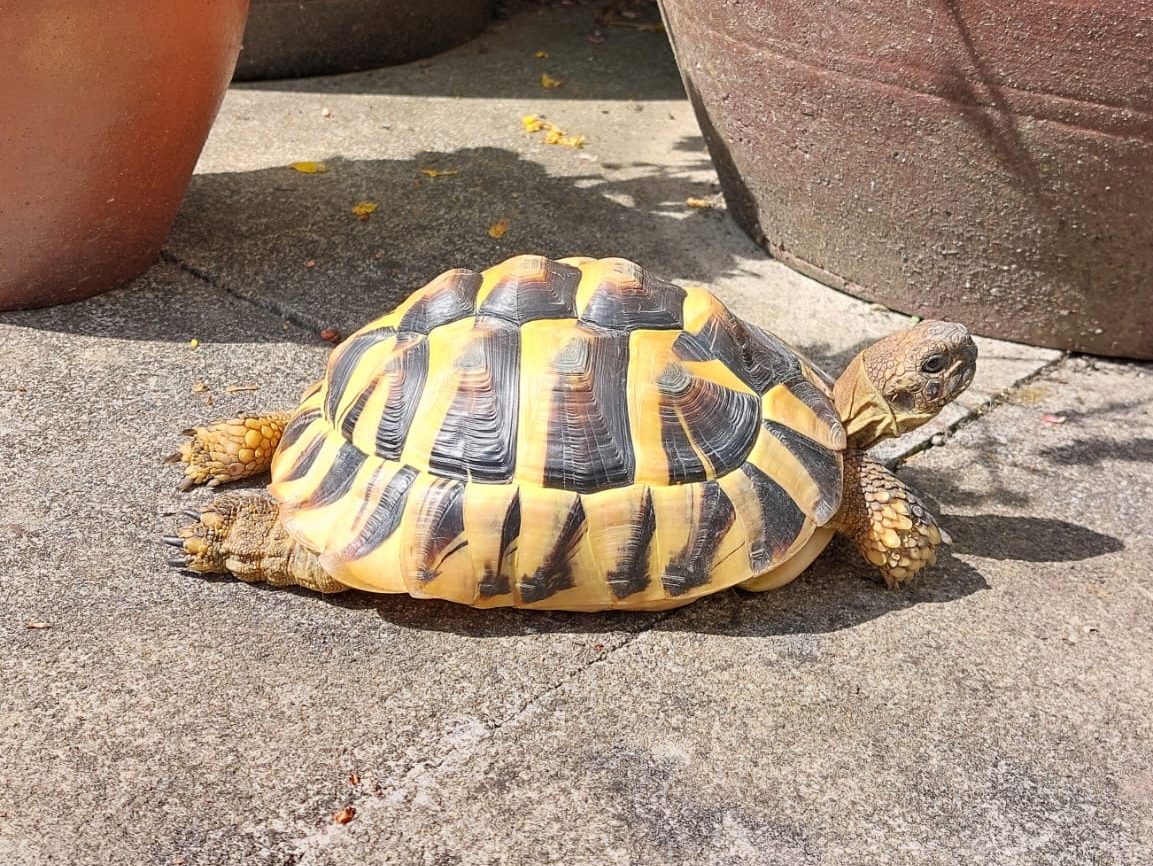
This is handy, as it often lets us know whether it’s suitable to let the tortoise out for a stroll too.
Barley doing her yoga on the patio tiles
A bit of natural sun makes all the difference to a heat lamp for her, which I’m sure we can all agree with (I’m terribly anti-Big-Light these days). I don’t know if tortoises contain or produce serotonin, but their heat-seeking (survival) instincts resonate strongly with me.
It may sound extreme, but things simply feel more doable when the Sun is out. I have all the instincts of a hibernating animal, who has been cooped up much too long and all of a sudden feels much lighter (in more senses than one).
Perhaps this is just a reflection on my grasping at any sense of optimism nowadays, if merely a bit of warmth through my joints: life feels that bit more liveable, I don’t feel half as unwell as the cloudy day before, and for some reason my body works a bit better than usual. I feel suddenly inspired, as though I’ve quite literally had some light switched on somewhere in my brain.
Seeing Project Hail Mary at the weekend (enjoy it!) seems to have inspired me to think about our Sun and perhaps worship it a bit more than before. This, and a particularly glare-y bus journey home.
I suggest we all pause and bask (responsibly) for a bit.
(Title taken from ‘I have to tell you’ by Dorothea Grossman)
The passing of another year and plunge back into dark nights and crisp white mornings fills me with the inherent (albeit mouse or moomin-like) longing to hibernate.
I should have an affinity with snow, having been born on a particularly blizzardous February night, yet creaky joints and a fear of slippy ground means I much prefer snowfall through the window when I’ve nowhere else to be.
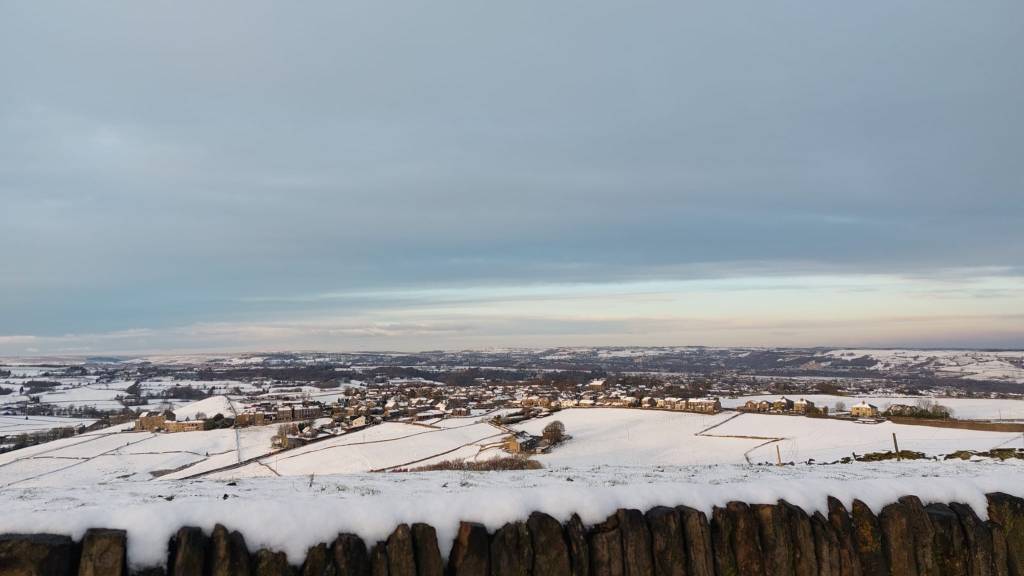
Snow at home, early last year
There is something about waking up to a world transformed when there has been snow overnight. The landscape is suddenly limited to a minimal colour palette: black, white, then the palest pink and blue… It is funny how somewhere that can be once so green (that being the rolling hills of home for me) can appear so flat.
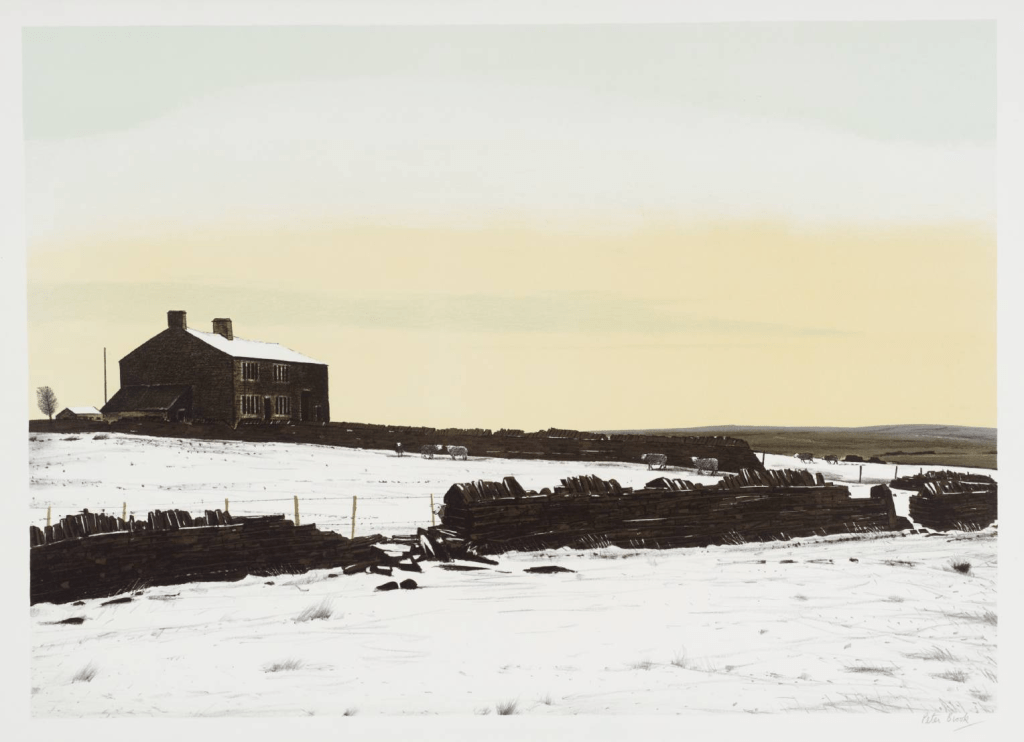
Peter Brook is one of my family’s favourite artists, and at this time of year I find myself inside his paintings.
Peter Brook, Sheep Coming In (December)
Whilst every natural instinct insists I bundle up, away from the cold, I’m usually unluckily tied to commitments in places unaffected by my particular snow cloud. This happened this week, where everyone’s anticipation of a snow day from Storm Goretti ended in a disappointing Friday morning: arriving at work, it was as though not a single bit of ice remained!
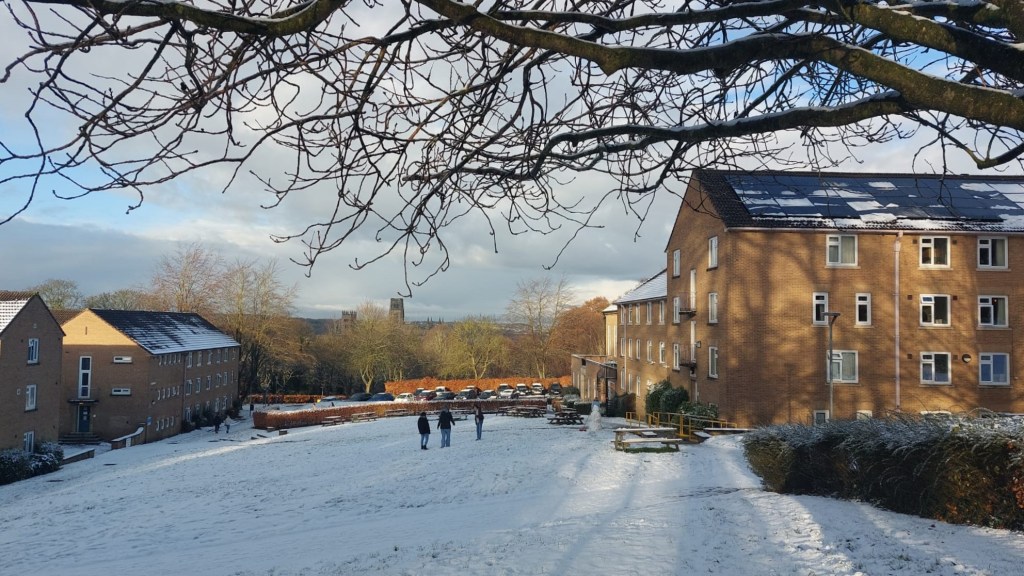
Still, the little hill upon which I reside (much like Peppa Pig) was a snowglobe.
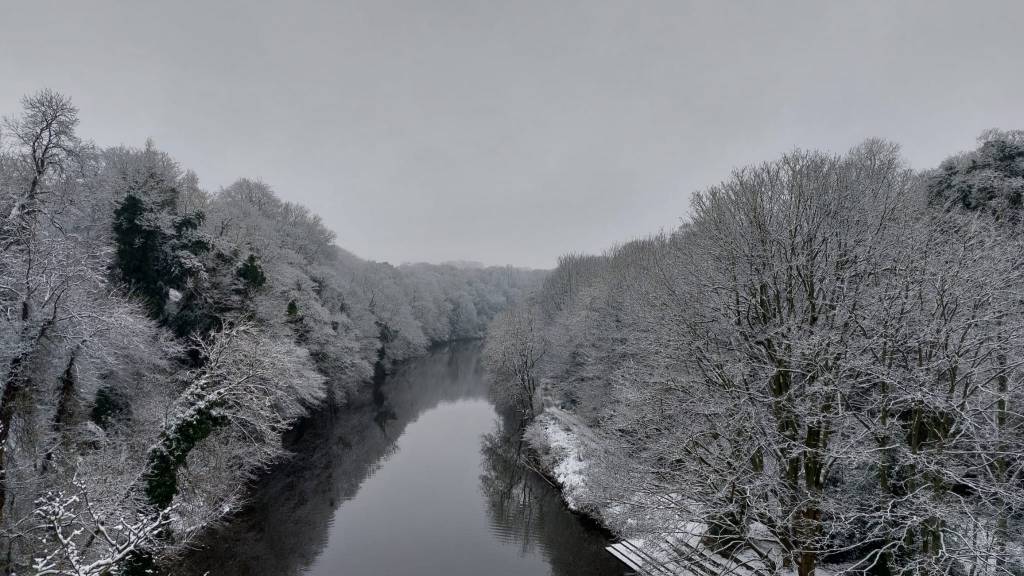
Durham snow day in 2023
Approaching springtime and the return of all good things (namely light and colour), I am reminded of when I lived in Durham and walked my daily walk to the library to work on my third-year dissertation.
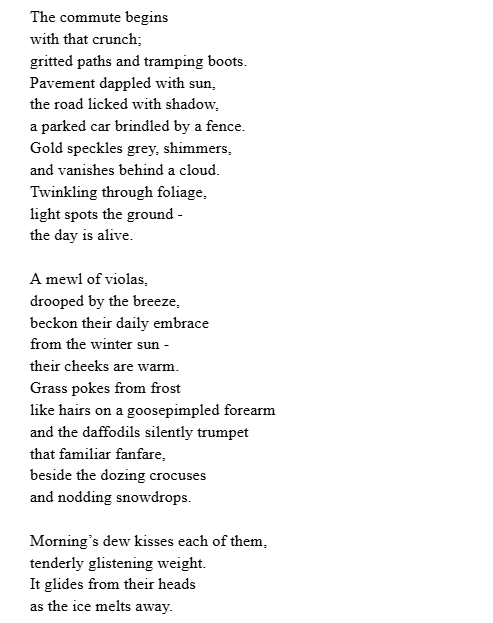
I can’t remember exactly when I wrote most of this poem, but I will include it below.
I wish everyone well as we start 2026 full of the usual mix of optimistic hesitancy. May you hear from me a bit sooner than before.
This year I set out to truly understand and come to terms with myself, which has naturally led to reflecting on the aspects of my childhood that have ultimately shaped me.
Growing up neurodivergent and anxious, I have often felt an imposterish sense that I’ve been handed a faulty manual. I’m haunted by an immense fear that one day, a stranger will turn to me, point, and tell me I’ve been doing life wrong – and everyone has noticed.
This was recently tested before our flight to Tenerife over a month ago, when I had my hand luggage searched at about 5:30am in Manchester Airport. It is moments such as these that you convince yourself that maybe you arecarrying things you shouldn’t, maybe you did fill it with the most embarrassing, incriminating, items, maybe you are the worst person on earth…
But I had only packed a few hours beforehand (I all-nightered to leave at 4am). As a fan of lists and puzzles with photographic memory, I had a pretty decent idea of what was in my bag.
That makes it sound like I passed the check with flying colours (what is it with me treating life as some big exam!). This was roughly how it went. My bag is black and white, polka-dotted.
Security 1: Is this your bag?
Me: Yes, it is.
Security 1: Did you pack this bag yourself?
Me: Yes, I did. (I know I definitely did, but what if I actually didn’t)
Security 1: Is everything in this bag yours?
Me: Yes, it is. (Am I sure???)
Security 1: Is there any chance somebody could have taken and/or added something to your bag?
Me: No. (I’ve been clinging to this bag since 3:45am, but what if…)
My deer-in-headlights expression (more lately rabbit-in-headlights from my driving instructor) is on by now.
Security 1: Can you list what you have packed in this bag for me?
Me: (Instructions. I’m good at those. I literally just packed this bag) I have my hairbrush, Nintendo Switch, sunglasses, cap (ARE THESE THINGS YOU NORMALLY TAKE ON HOLIDAY???), toothbrush, books… headphones…
Security 1: Okay. If I were to ask you about two or three rectangular things towards the right-hand-side of your bag, could you think what they are?
Me: Either books, or… (oh, wait). I packed some card games.
Security 1: Can you remember what card games?
Me: (Very aware of people behind me at this point) Cat Top Trumps and The Chase (ITV) card game.
Security 2 then proceeds to remove everything in my bag and search them (the books page by page… my poor secondhand Wimsey). This is when I’d forgotten to mention my childhood teddy, Lucy the lamb, is also in there. She got swabbed for drugs. I kind of wanted to spontaneously combust at that point. Security 2 did apologise for that.
Following an all-clear and a fairly deflated departure from Security, my dad suggested they maybe wanted to check my bag because they were astounded at how a 24-year-old could have a bag filled by a child and grandmother simultaneously.
I was worried that maybe they thought my Tetris style of packing was too neat, and therefore a red flag. I have since reassured myself that no, it wasn’t my Crocs, or my bad eye contact, but simply a random check.
A “Build a Bel” Starter Pack, by me
There is nothing like a good bit of self-scrutiny following having your belongings searched and representation of your personality quite literally laid out in a tray, piece by piece. This debacle occurred at about the same time an online trend of (predominantly AI-generated) Me Starter Packswas circling: see my (drawn!!!!! by hand!!!!!) contribution above. Some of the objects pictured featured in my hand luggage.
Aside from its relevance to the mortifying ordeal of being known, I brought up the airport scene for purposes of reflecting on material identity. Not exactly to say that I’m best described by card games and a toy lamb, but more in the way the things we own, inherit, keep, treasure, capture aspects of our lives/passions/younger selves.
I am a person with interests (special interests) of multiple shapes and sizes, yet also one who when asked about hobbies will draw a complete blank, despite hyperfixated years attentively studying actor Personal Life sections or rewatching the same series on loop.
So, I think if I’m ever asked again, I might tell them about the bag search – both to jog my memory, and hopefully spark at least one common interest.
I may poke fun at myself, but a lot of becoming who I am now has involved re-embracing the things I enjoyed as a little girl and might have packed away when teenagerhood convinced me that everything was embarrassing.
Of course I wake up finally
thinking, how wonderful to be who I am,
made out of earth and water,
my own thoughts, my own fingerprints —
all that glorious, temporary stuff.
(From Mary Oliver, ‘On Meditating, Sort Of’)
I was labelled an old soul on a number of occasions growing up, which I took then as more a comment on my hobbies (arts, crafts, baking, watching daytime detective TV…). I have of course read more into it now I’m older and realised it ties more into emotional maturity and oftentimes introversion, which has led to other discoveries regarding the past ten years or so.
Whether it be due to exposing myself to the internet at much too young an age (11-12), being bullied at school (I recently found some online journals I had written detailing times I was – I seem to have either shut most out or forgot), or whatever anxiety chucked in the way when all I wanted was to pass my GCSEs and A Levels; I would probably say that I grew up quickly in some areas.
I can’t say confidence blossomed, or a social life, but more so that I have, for a long time now, felt hyper-aware and almost constantly on-guard.
Something I have tried (and am trying) to do as of late is actively seek to heal/re-seek my inner child. This, and challenging embarrassment. Having spent a portion of life pretending to be someone, something I’m not (neurotypical, heterosexual, modern pop-cultured), what’s the harm in finding some happiness in old hobbies?
I’ve started reading previously adored children’s books before bed. I returned to the Brownie unit I was at as a child and now volunteer there. I’ve started drawing and sewing again. I routed through the stacks of boxes in my childhood bedroom and put out some trinkets I treasured as a girl.
A wall in my bedroom, my space for twenty-four years
After a long period of cluttered minimalism (meaning this in the sense my space has been simultaneously undecorated, personality-less, yet a mess), I’ve found a lot of enjoyment in bringing the colour back. I believe in dopamine dressing – similarly in dopamine decorating!
Whether it be merely the return of sun and heat, or that I’m making some positive steps forward, I have found real comfort in taking life slowly, feeling less pressure, and allowing myself to just be.
(Lines taken from ‘when faces called flowers float out of the ground’, E.E. Cummings)
It is all too easy to find ourselves worked into mental corners, to white-knuckle the temples with every wish of quieting worry or hushing an irrational thought. As an anxious person (likened once to a deer in headlights, once to the ever-paddling swan…), I – naturally – think a lot. Think about the endless possibilities of the everyday, yes, but also think a lot about thinking.
Today, I thought I’d share some of those with you.
The (often) vicious cycles of thought and over-thought can be disruptive, detrimental. An anxious spiral, overload of sensory input, or intrusive/harmful thinking each forge internal battles between the mind and self.
Belief systems that we unknowingly create can inflict themselves when triggered (sometimes without), and render us tethered to, knotted into overthinking. Anxiety, panic, fear and other sensitivities, can exacerbate – tangle – what may have begun as a small worry can soon expand.
An overstimulated mind can reach boiling point; one may melt down, another could freeze. For some with a perpetual nervous monologue, it can simmer on.
R.D. Laing, Knots, p. 36 – infinite thought cycle – persistence of imposter syndrome?
The title of this post is taken from R.D. Laing’s Knots (1970), which I have already alluded to, and included an example above. It is a work that is difficult to categorise: poetry, prose, flowchart? I suggest, if you’re interested, to take a look online…
This particular bit (above) is actually a later iteration of a longer poem – built from the same concept, same words:
I am not entitled to it/because I have stolen it./I have stolen it/therefore I am not entitled to it./I am not entitled to it/therefore I must have stolen it./Or, it has been given to me as a special/favour/by someone who is entitled to it/so I am expected to be grateful for all I/have/because what I have/ has been given, not stolen.
(Knots, p. 34)
Written here without its structure, you can see Laing’s vision; he is depicting the busy mind and the repetitious impasses one may get into through overthinking.
My first encounter with the text was one unrelated, long before my interest in literary anxiety. It was actually Edward Petherbridge and his YouTube channel (always a delight) where he has uploaded poems, reflections, art, along with various clips from his 1975 staging of Laing’s work.
Some old drawings depicting a couple of mime EPs in Knots (1975), by me
When spoken aloud, Knots is perhaps less overwhelming than initially seen on the page, yet it still succeeds in driving the reader in (sometimes literal) circles.
Its incessant repetition resembles the sensations of a busy brain that I have found done effectively elsewhere via stream of consciousness narration (Woolf, Joyce, Eimear McBride’s A Girl Is a Half-Formed Thing a more recent example).
Feeling inspired, I revisited my postgraduate dissertation, which interpreted various aspects of E.M. Forster and his works as moments of Anxiety, Overstimulation and Eruption (and is also the inspo for this blog’s URL!). I’m hoping to re-engage with this area of interest in future, however I will take a section to illustrate before I proceed…
At just eleven years old, Forster writes a letter to his mother of his fears, anxiously envisioning certain moments, or ‘instances’, that could hypothetically arise:
I feel so very nervous somehow. I don’t know why it is but perhaps it is excitement, but lately I have always been taking the dark side of things. I have never been like it before, but it is not all nice. It is very much like despondency; I am afraid I shall miss the train in the morning, afraid you will not meet me, afraid I shall lose my tickets; those are instances of the kind of state of mind I am in; it is not so bad in the day-time as at night, then I cry a lot.
(E.M. Forster, ‘To Alice Clara Forster, December 1890’)
Sigmund Freud writes that ‘anxiety has an unmistakable affinity with expectation: it is anxiety about something. It has a quality of indefiniteness and a lack of object.’ Young Forster’s ‘despondency’ in the extract above, ‘afraid’ repetitively of multiple potentialities, demonstrates a distinct apprehension towards anticipated risks. In this listing of fears to his mother, with whom he shared an incredibly close relationship until her death, his nervous sensibility is clear from a young age. His low emotions, and association of such feelings with the night-time, can also be likened to a teenage Maurice, an arguably autoethnographic protagonist, and not only for his nominal similarities with the young Edward Morgan. Early in the novel, following an anxious outburst upon hearing of the gardener’s departure, Maurice endures ‘a great mass of sorrow that had overwhelmed him by rising to the surface’, soon taking to bed where, ‘His heart beat violently, and he lay in terror, with all his household close at hand’ (M, p. 14). In isolation, in darkness, ‘he was afraid’ (p. 14), not dissimilarly to young Forster, who in his letter explains that the night-time causes his worries to worsen, and ‘then […] cry a lot’.
(Feeling ‘unspeakably oppressed’: Moments of Anxiety, Overstimulation and Eruption in E.M. Forster. University dissertation submitted September, 2023)
The quotation I included above from one of Forster’s letters is all too familiar to those who worry – the haunting ‘what if’ that snowballs into questioning the outcome of everything to come… as Freud puts it, that notion of expectation, of waiting for the unknown, and fearing it.
In many cases, avoidance is often the answer. It is natural that thought and action are intrinsically linked; as creatures of habit, we are influenced heavily by how things make us feel.
Alternatively, small comforts, exercise, good company, better weather, caffeine, are each examples of things we might actively seek for that boost of serotonin and/or energy. Even the sun feels that bit more restorative now. I for one can admit that the step from dark winter into the light and air of spring gets increasingly welcome as the years go by.
Some daffodils and a double-yolker I turned into a face in 2021 – fun in lockdown…
However, there is always a pang of guilt, alike to that of an unproductive New Year’s Day, or an unfulfilled vacation, that seems to follow the rise of the daffodils, fall of April showers, the changing clocks (the loss of an hour… makes you dwell on every wrong you could have righted).
The pressure of new beginnings poke ideas of mass productivity into otherwise still-waking-from-hibernation brains. We’re still adjusting – coming to terms with what for some tends to be a darker period, mentally, of the year. What is one supposed to do when the habits are bad, and the routines aren’t there?
Thus, the knotlike cycle continues, and I return to where I started writing: how easily we find ourselves returning to doubt…
As I said before, I am a big thinker (forgive the chaos of this post), and while I have a bounty of thoughts circling, I thought it worth trying to embrace my inner R.D. Laing (and executive dysfunction) to finish.
It’ll never get done
Because
I’m scared to make a start
I’m scared to make a start
Because
It’ll never get done
If you made it to the end of this, thanks so much for reading. I’ve been in a veritable slump as of late, hence the inactivity, but am hoping I may return from a week away in the sun with some ideas up my sleeve.
I would like to wish any readers some rather belated New Year wishes. As if by magic, January has frustratedly flown by, and my next post comes to you much later than I had planned – or, at least – hoped.
The title of this post is partly taken from one of Emily Dickinson’s Envelope Poems, which I am always reminded of at the end of a year. ‘In this short Life that only lasts an hour/How much – how little – is within our power’… She writes of living life to the full, how much can change, happen, exist, within a life, contracted to an hour.
Emily Dickinson, Envelope Poems (W. W. Norton & Company, 2016), p. 30
But, it is important to note ‘How much – how little’ we can control. There is so much pressure put on the figurative refresh a new year brings, which I have known only too well.
I mentioned in my previous (and only) blog post that I am often filled with big ideas that don’t necessarily happen. I have semi-unknowingly proven this, for over the past three weeks I kicked myself at least twice a day for not writing anything new. Yet, simultaneously, I did expect this to happen. It is no secret that cold January and its associated SAD hits many – I found myself snowed under, in more ways than one…
The snow from my [Bed]Room with a View, last week
I could easily spiral into frustration and kick myself again for the lack of productivity, but that is not the point I would like to make.
This clinging to the notion of wiping a slate clean, of starting anew, has become cyclical; not only yearly, but daily, weekly, hourly. I am guilty of trying to combat my Sunday scaries with an ‘I’ll start on Monday’ before bed, or setting timers or rewards for doing the bare minimum. But, I’ve come to terms with the fact that this rarely works. For me, that is.
It was actually a random Tumblr post by a since-deactivated user that struck me a few weeks ago. It said:
NEVER LET YOURSELF BE STOPPED BY WHAT IT WOULD HAVE BEEN LIKE IF YOU STARTED EARLIER!!!!! THE ONLY TIME WE HAVE IS NOW
Its aggressive uppercase has stayed in my mind, and has since become the angel on my shoulder, opposite the constant irritation of self-loathing I get whenever I am less productive than hoped. It is only too often that I upset myself with what-could-have-been-if-I-started-earlier. Instead, it is about time I started to congratulate myself more for doing something, regardless of how long it took. I shouldn’t be ashamed for working a particular way.
Having grown up through varying stages of self-esteem, self-motivation, and self-awareness, I am only now beginning to understand how I work. Harking back, I worked much too hard on my A-Levels (lack of sleep and self-care actually led to a hypothyroidism diagnosis at eighteen). The pressure I put on myself through a perfectionist’s fear of failure and generalised anxiety wasn’t great, needless to say.
Being quite the opposite of busy today, I cannot fathom how I ran on fumes for so long. However, it was questions like these that led me to stop and remind myself of various challenges I have faced since I was a teen; the pandemic, processing trauma, two broken arms… I feel as though I’ve come out of five years of living in survival mode.
It was primarily a COVID-affected university experience that helped me recognise how poorly I worked from home; I found myself close to fifty pre-recorded lectures behind at one point in my second year (2020-21). Prior to then, I had never considered that I could be neurodivergent, and that the lack of structure was simply not helpful.
Skipping to now, I am fairly certain I’m AuDHD (and characteristically procrastinating seeking diagnoses). If I had had more understanding of myself and what works for me years before, I might not have had so much inward anger. But: it is not worthwhile (yet) to reflect on what could have been (watch Rick Glassman discuss his late autism diagnosis with Rainn Wilson).
As I already said, I have only lately been coming to terms with my brain. This reframing of my mind combined with various rounds of CBT, and generally a lot of contemplation has assisted me in knowing my limits, triggers, routines.
I now know what is unsustainable for me and how exercise or work makes me feel better. I now understand that it’s better I stop and sleep, start tomorrow, instead of staying up late, accomplishing little, and inevitably hating myself more. Was I unproductive today, or did my body actually just need a rest? Am I actually incapable of getting this done, or have I just not eaten/taken a break/slept enough?
Some fireworks at Belvoir Castle, August 2024
Now, I would like to say that affirmations such as these have single-handedly fixed the relationship I have with myself. The unpredictability of chronic and mental illness, the nature of life generally, are constant challenges to that. I cannot in any way pretend that my life is perfect because I’ve kind of ‘figured me out’, because I haven’t really yet. I am still a burnt out unemployed twenty-something who hasn’t actually left the house properly in over a week.
There is a lot to go by way of living better – and the best way for me to start that is to reassure myself that although life may sometimes feel like it’s passing me by, it is not worthwhile brooding over could-haves. Amidst adhering to real deadlines, there are some things that will come when ready – me included.



 AS YET TO BE